
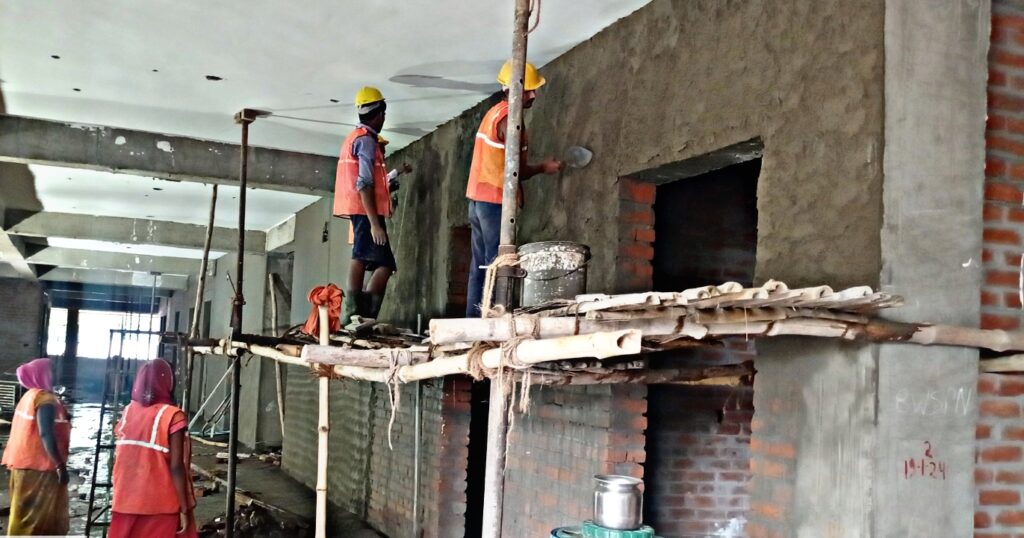
Plaster work is one of the most important finishing activities in building construction. A good plaster surface not only improves the appearance of walls but also protects them from moisture, weather, and damage. However, before starting plastering work, it is very important to calculate the correct quantity of cement and sand required. Proper calculation helps in saving cost, avoiding material wastage, and ensuring smooth workflow at the construction site.
In this article, we will understand how to calculate cement and sand for plaster work in a simple and practical way, along with formulas, examples, and important site tips.
Basic Information Required for Plaster Calculation:
Before calculating materials, we need three important details:
- Length of wall (L)
- Height of wall (H)
- Thickness of plaster (T)
We also need to know the plaster mix ratio, such as:
1:3 (Cement : Sand)
1:4
1:5
1:6
For internal walls, 1:5 or 1:6 is commonly used. For external plaster, 1:4 or 1:5 is generally preferred.
Step 1: Calculate the Area of Plaster
Area of plaster = Length × Height
For example:
If wall length = 15 ft
Wall height = 10 ft
Area = 15 × 10 = 150 sq.ft
Step 2: Convert Plaster Thickness into Feet
Normally plaster thickness is 12 mm or 15 mm.
12 mm = 0.012 m = 0.04 ft (approx)
15 mm = 0.015 m = 0.05 ft (approx)
Let us assume plaster thickness = 12 mm (0.04 ft)
Step 3: Calculate Wet Volume of Plaster
Wet Volume = Area × Thickness
Wet Volume = 150 × 0.04
Wet Volume = 6 cubic feet (cft) approximately
Step 4: Convert Wet Volume into Dry Volume
When we mix cement and sand, dry materials occupy more volume due to voids. So we multiply wet volume by a factor of 1.27 to 1.33.
For plaster work, we usually take 1.30.
Dry Volume = 6 × 1.30
Dry Volume = 7.98 cft
Step 5: Calculate Cement and Sand Quantity
Assume plaster ratio = 1:5
Sum of ratio = 1 + 5 = 6
Cement Quantity
Cement = (1 / 6) × 7.98
Cement = 1.33 cft
Now, 1 bag of cement (50 kg) ≈ 1.23 cft
Number of cement bags = 1.33 / 1.23
= 1.08 bags (approx 1.1 bags)
In kg = 1.08 × 50 = 54 kg cement
Sand Quantity
Sand = (5 / 6) × 7.98
Sand = 6.65 cft
Final Material Required
For 150 sq.ft wall area with 12 mm thickness and 1:5 ratio:
Cement = 1.1 bags (approx 53 kg)
Sand = 6.65 cft
Important Practical Points
Always deduct door and window openings from total wall area.
Add 5–10% extra material for wastage.
Use clean sand free from clay and organic matter.
Maintain proper water-cement ratio for better bonding.
Ensure proper curing for at least 7 days.
Quick Formula for Plaster Material Calculation
You can use this simple formula:
Cement (bags) =
(Area × Thickness × 1.33 × Cement Ratio) ÷ (Total Ratio × 1.23)
Sand (cft) =
(Area × Thickness × 1.33 × Sand Ratio) ÷ Total Ratio
Why Accurate Calculation is Important?
Prevents material shortage at site
Avoids unnecessary extra purchase
Reduces project cost
Ensures smooth construction work
Helps in proper estimation and billing
Incorrect calculation may lead to uneven plaster thickness or quality issues.
Frequently Asked Questions (FAQs)
- What is the standard thickness of plaster?
For internal walls, 12 mm thickness is common. For external walls, 15–20 mm thickness is generally used.
- Which plaster ratio is best for internal walls?
1:5 or 1:6 (Cement : Sand) is commonly used for internal plastering.
- Why do we multiply by 1.33 to get dry volume?
Because dry materials contain voids, and extra volume is required after mixing with water. So we convert wet volume into dry volume using a factor between 1.27 to 1.33.
- How much area can one cement bag cover in plastering?
For 12 mm thick plaster in 1:5 ratio, one cement bag can cover approximately 120–140 sq.ft area (approximate value).
- Should openings be deducted in plaster calculation?
Yes, always deduct door and window areas for accurate calculation.
Conclusion:
Calculating cement and sand for plaster work is not difficult if you follow the correct steps. First calculate the plaster area, then find the wet volume, convert it into dry volume, and finally divide according to the mix ratio. Accurate estimation saves money, reduces wastage, and ensures good quality finishing work.
Understanding these basic calculations is very important for civil engineering students, contractors, and site supervisors. With proper planning and calculation, plastering work becomes smooth and cost-effective.