
Brick calculation is one of the most fundamental tasks in construction. Whether you are a civil engineering student, site engineer, contractor, or builder, knowing how to calculate the number of bricks in a wall is essential. Accurate estimation helps control material cost, reduce wastage, and avoid delays at the construction site.
In this article, we will explain the complete method of brick calculation in a simple and practical way. We will also solve a real example and include frequently asked questions at the end.
Understanding Standard Brick Size
Before starting the calculation, it is important to understand the size of a brick.
In India, the commonly used brick sizes are:
- Actual Brick Size (Without Mortar)
19 cm × 9 cm × 9 cm
In meters: 0.19 m × 0.09 m × 0.09 m
This is the physical size of the brick itself.
- Nominal Brick Size (With Mortar)
In construction, bricks are laid with mortar joints. Usually, a 10 mm (1 cm) thick mortar joint is considered.
So, the nominal size becomes:
20 cm × 10 cm × 10 cm
In meters: 0.20 m × 0.10 m × 0.10 m
For brick calculation in wall construction, we generally use the nominal size (with mortar) because mortar is part of the brickwork.
Step-by-Step Method to Calculate Number of Bricks
The basic formula used for brick calculation is:
Number of Bricks = Total Volume of Wall / Volume of One Brick
Let us understand each step clearly.
Step 1: Calculate the Volume of the Wall
The formula to calculate wall volume is:
Volume of Wall = Length × Height × Thickness
Example:
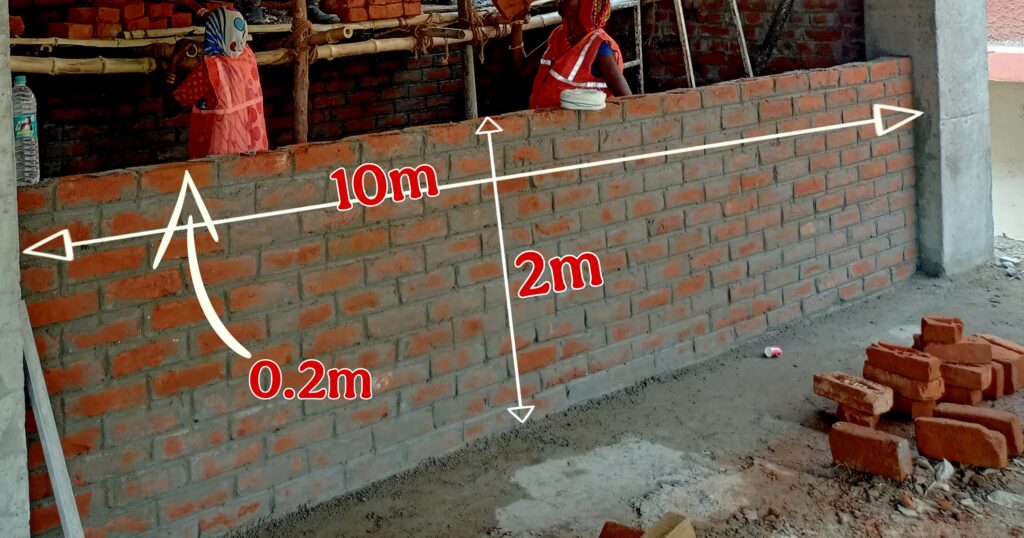
Assume the wall dimensions are:
Length = 10 meters
Height = 2 meters
Thickness = 0.2 meters
Now calculate:
Volume = 10 × 2 × 0.2
Volume = 4 cubic meters
So, the total volume of the wall is 4 m³.
Step 2: Calculate the Volume of One Brick
Using nominal brick size (with mortar):
0.20 m × 0.10 m × 0.10 m
Volume of one brick:
= 0.20 × 0.10 × 0.10
= 0.002 cubic meters
So, the volume of one brick is 0.002 m³.
Step 3: Calculate Number of Bricks
Now apply the formula:
Number of Bricks = Wall Volume / Brick Volume
= 4 / 0.002
= 2000 bricks
Therefore, 2000 bricks are required to construct this wall.
Adding Wastage in Practical Construction
In real construction work, some bricks are damaged during transportation, handling, or cutting. Therefore, it is necessary to add 5% to 10% wastage.
If we add 5% wastage:
5% of 2000 = 100 bricks
Total bricks required:
2000 + 100 = 2100 bricks
So practically, you should order 2100 bricks for safe construction.
Important Practical Considerations
- Deduction for Doors and Windows
If the wall contains openings such as doors or windows, their volume must be deducted from the total wall volume before calculating the number of bricks.
- Wall Thickness Matters
Different wall thicknesses require different numbers of bricks:
4.5 inch wall (115 mm)
9 inch wall (230 mm)
13.5 inch wall (345 mm)
The thicker the wall, the higher the brick requirement.
- Mortar Thickness
Standard mortar thickness is 10 mm. If mortar thickness changes, brick quantity may slightly vary.
Shortcut Method for Quick Estimation
For quick site estimation, engineers often use a thumb rule:
Approximately 500 bricks are required for 1 cubic meter of brickwork (including mortar).
In our example:
Wall volume = 4 m³
Required bricks = 4 × 500
= 2000 bricks
This method is very useful for fast estimation at site level.
Why Accurate Brick Calculation Is Important
Helps in proper budgeting
Prevents material shortage
Reduces wastage
Improves project planning
Maintains contractor profit
Wrong estimation can cause either extra purchasing or construction delays.
Frequently Asked Questions (FAQs)
- How many bricks are required in 1 cubic meter of brickwork?
Generally, about 500 bricks are required in 1 cubic meter of brickwork including mortar.
- Should we use brick size with mortar or without mortar?
For wall construction calculation, brick size with mortar (nominal size) should be used because mortar joints are part of brickwork.
- How much wastage should be added in brick calculation?
Usually, 5% to 10% wastage is added depending on site conditions and handling quality.
- How to calculate bricks for a wall with doors and windows?
First calculate total wall volume, then subtract the volume of openings (doors/windows), and finally divide by brick volume.
- How many bricks are required per square meter?
For approximate estimation:
9 inch wall: about 120 bricks per square meter
4.5 inch wall: about 60 bricks per square meter
- Can brick calculation be done using square meter method?
Yes, it can be done using standard brick consumption per square meter, but the volume method is more accurate.
Conclusion:
Brick calculation is a basic yet essential concept in construction engineering. By using the simple volume method, you can easily calculate the number of bricks required for any wall. Always use nominal brick size (with mortar), deduct openings, and add wastage for practical accuracy.
Accurate brick estimation not only saves cost but also ensures smooth construction progress.