
Civil engineering is one of the oldest and most important branches of engineering. Almost everything we use in daily life— homes, roads, bridges, water supply, drainage systems, and cities—exists because of civil engineering. In simple words, civil engineering is the backbone of modern society. It focuses on planning, designing, building, and maintaining infrastructure that people use every day.
This article explains civil engineering in a simple, practical, and easy-to-understand way, making it perfect for students, beginners, and general readers.
What Is Civil Engineering Profession?
Civil engineering is a professional engineering field that deals with the design, construction, and maintenance of public and private infrastructure.
Simple definition:
Civil engineering is the branch of engineering that deals with buildings, roads, bridges, dams, canals, and water systems. Civil engineers use knowledge of maths, physics, materials, soil, and environment to make structures that are safe, strong, economical, and long-lasting.
Why Is It Called “Civil” Engineering?
The word civil comes from civilian. Earlier, engineering was mainly related to military works like forts and weapons.
Civil engineering was introduced to describe engineering work done for public use, such as roads, buildings, and water systems.
History of Civil Engineering (In Simple Words)
Civil engineering started when humans learned how to build shelters and manage water.
Ancient Civil Engineering Examples:
Egyptian pyramids– advanced construction skills
Roman roads and aqueducts– transport and water supply
Ancient canals – irrigation and farming support These structures were built without modern machines, yet many still exist today.
Modern Civil Engineering
During the Industrial Revolution, cities expanded rapidly. This created a need for trained engineers, proper planning, and safety standards.
That’s when civil engineering became a formal profession with colleges, degrees, and rules.
Scope of Civil Engineering
The scope of civil engineering is very wide. It includes small homes as well as huge national projects.
Civil engineering covers:
- Houses, apartments, offices, factories
- Roads, highways, flyovers, and bridges
- Dams, canals, and irrigation systems
- Water supply and drainage systems
- Railways, metros, airports
- City planning and smart cities
Wherever construction exists, civil engineers are involved.
Major Branches of Civil Engineering
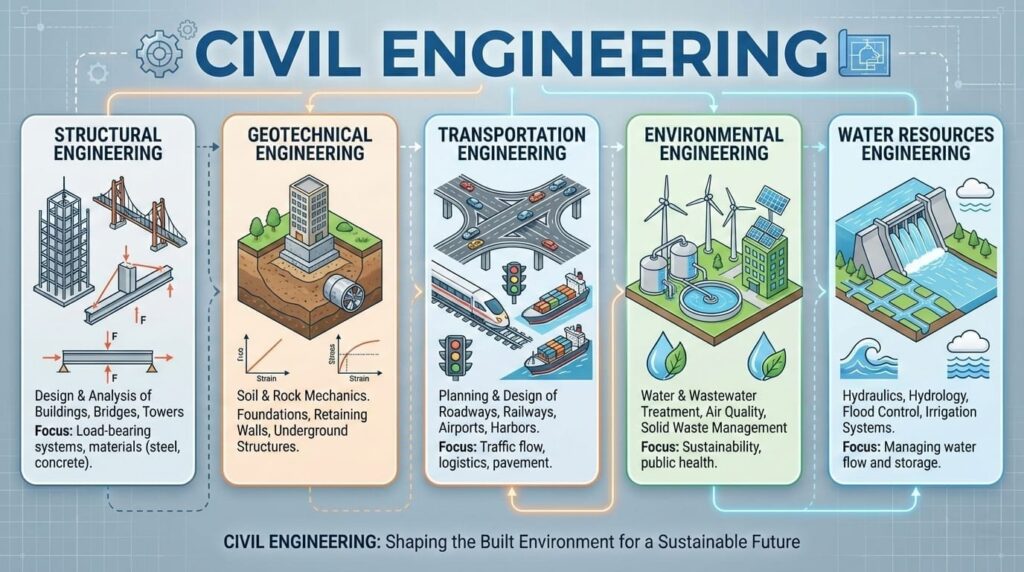
Civil engineering has many specializations. The main ones are:
- Structural Engineering
Structural engineers design buildings, bridges, towers, and slabs.
Their job is to make sure structures can handle loads, wind, and earthquakes safely.
- Geotechnical Engineering
This branch deals with soil and foundation design.
Geotechnical engineers decide what type of foundation is suitable for a structure.
- Transportation Engineering
It focuses on roads, highways, traffic systems, railways, and airports.
- Environmental Engineering
Environmental engineers work on:
- Water treatment
- Sewage systems
- Waste management
- Pollution control
- Water Resources Engineering
This branch deals with dams, canals, flood control, irrigation, and water storage systems.
- Construction Engineering & Management
This field focuses on planning, cost control, scheduling, quality, and site management.
What Does a Civil Engineer Do?
A civil engineer works from the start of a project to its completion.
Planning & Design Stage
- Site inspection and surveys
- Cost estimation
- Design drawings and calculations
- Material selection
Construction Stage
- Site supervision
- Quality and safety checks
- Managing labour and materials
- Solving on-site problems Maintenance Stage
- Inspection of old structures
- Repair and strengthening work
- Infrastructure upgrades
Importance of Civil Engineering
Civil engineering plays a major role in everyday life.
Infrastructure Development
Good infrastructure improves transportation, housing, industries, and public facilities.
Public Safety
Civil engineers design structures to resist:
- Earthquakes
- Floods
- Heavy loads
- Weather conditions
Economic Growth
Better roads, buildings, and cities create jobs and support business growth.
Environmental Protection
Modern civil engineering focuses on:
- Sustainable construction
- Eco-friendly materials
- Water conservation
Modern Technology in Civil Engineering
Today, civil engineering uses advanced tools to improve quality and speed.
Some commonly used technologies are:
- Building Information Modeling (BIM)
- GPS and drone surveys
- Advanced construction equipment
- Smart and green building materials
These technologies help reduce errors and save time and cost.
Career Options in Civil Engineering
Civil engineering offers many career opportunities:
- Site Engineer
- Structural Engineer
- Design Engineer
- Project Manager
- Quantity Surveyor
- Government Engineer
- Professor or Researcher
Civil engineers can work in private companies, government departments, or start their own consultancy or construction business.
Future of Civil Engineering
The future of civil engineering is focused on:
- Smart cities
- Green buildings
- Sustainable infrastructure
- Climate-resistant construction
With increasing population and urban development, the demand for civil engineers will always remain strong.
Conclusion
Civil engineering is more than just construction. It is about building a better and safer life for people. From small houses to large cities, civil engineers shape the physical world around us. For students and beginners, civil engineering offers a stable, respected, and meaningful career. It is truly one of the most important engineering branches in the world.