
Introduction
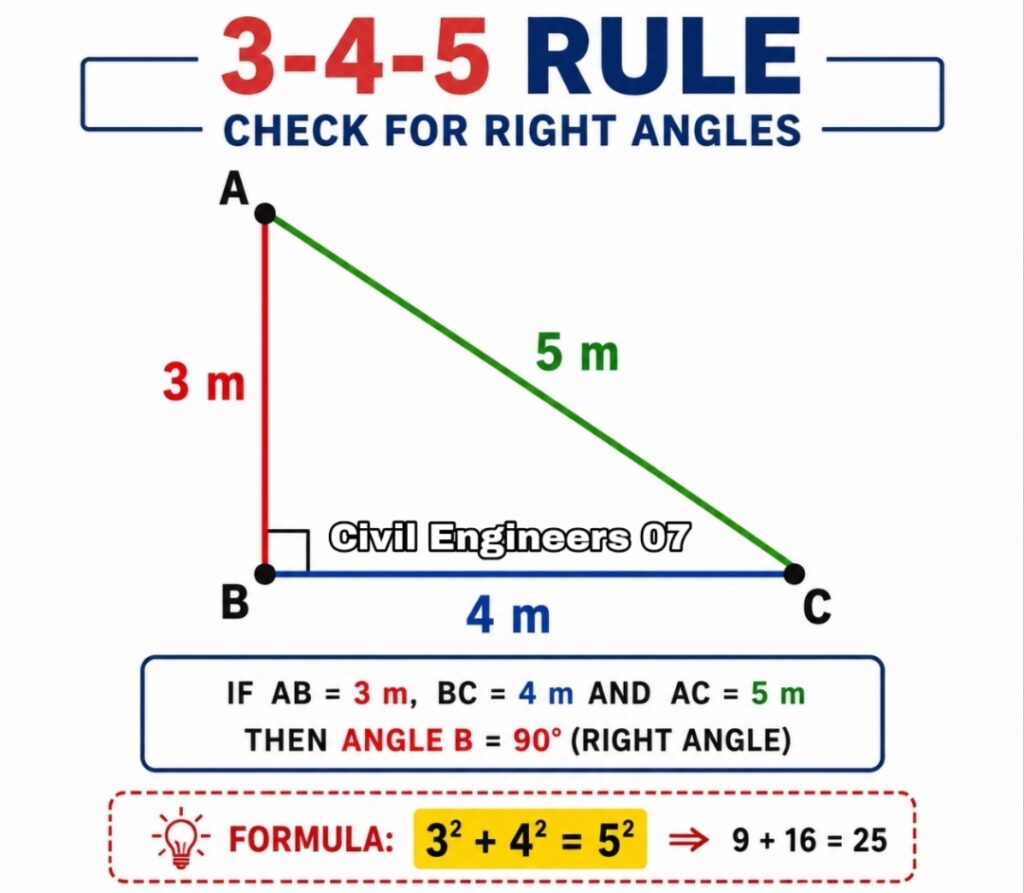
The 3-4-5 Rule is one of the simplest and most common rules used in civil engineering and construction to indicate a right angle (90º) on any construction site.
The rule is based on the Pythagorean theorem and can be used to set out building corners, foundations, walls, columns, rooms and many other items.
The 3-4-5 method is mostly used when precise surveying equipment is not available, or a right angle must be set out quickly on site.
What is the 3-4-5 Rule?
The 3-4-5 Rule is the idea that a triangle with two sides measuring 3 units and 4 units respectively, has a diagonal side (hypotenuse) with a length of 5 units.
Mathematically:
3² + 4² = 5²
9 + 16 = 25
√25 = 5
Which gives us a perfect right angle between the 3 unit and 4 unit lines.
The 3-4-5 Rule can be used in any units, as long as both sides are in the same units.
3-4-5 Rule Formula
The formula is simple:
3² + 4² = 5²
Where,
3 = First side
4 = Second side
5 = Diagonal (hypotenuse)
For a perfect right angle, the measurement of the diagonal should be 5 units (5 m or 5 ft.).
How to Use the 3-4-5 Rule to Set Out a Right Angle
Let’s understand how to use the 3-4-5 Rule to set out a right angle by carrying out an example.
Step 1: Choose a Point and Mark it
Find the point from which you will start setting out the first side of the right angle, and mark it as point A.
Step 2: Set the First Side
Set your first side from point A and measure 3 units along the side, and then mark it as point B.
So that you have a distance of:
AB = 3 m
Between A and B.
Step 3: Set the Second Side
From point A, mark approximately the second side of your layout (at a right angle to the first side), and measure 4 m, marking that position as point C.
This is shown below:
AC = 4 m
Step 4: Measure the Hypotenuse
Now measure the distance between point B and point C.
For a right angle, you should get:
BC = 5 m
As the distance between B and C.
3-4-5 Rule Example
Say we are to set out a line representing a corner of a building as described above.
The first side was 3 m, the second side 4 m, so we would expect to get 5 m between points B and C.
Let’s test this by checking if the data satisfies the Pythagorean theorem.
3² + 4² = 5²
9 + 16 = 25
Thus, it satisfies the Pythagorean theorem and we have a right angle between the two sides.
Using the 6-8-10 Method
We can use other multiples of the 3-4-5 method, for example:
3 × 2 = 6
9 + 16 = 250__
9 + 16 = 251__
So that we get the 6-8-10 Rule.
Similarly, you can use other multiples such as:
9-12-15 Rule
12-16-20 Rule
15-20-25 Rule
They all follow the same principle as the 3-4-5 Rule.
The higher multiples can be more useful on large sites as there is room for more error when using a smaller scale.
3-4-5 Rule for Building Layout
The 3-4-5 Rule is mostly used in building, or structure layout and setting. Some of the areas that may require the use of the 3-4-5 Rule include:
Checking and/or setting out building corners
Setting out foundation trenches
Checking the alignment of building walls
Setting out rooms and/or walls
Checking column centres
Setting out grid lines
Checking excavations and/or footing layout
Checking plinth lines
Checking construction lines
Why is the 3-4-5 Rule Important?
Any form of building layout requires accurate angles and dimensions since any error can cause great problems later.
If a building corner is not at right angles, we have problems arising from incorrect wall alignment, room sizes, tiling, window and door placement, foundation layout, column layout, and many other problems.
It is therefore important to check angles, especially when setting out a building layout.
3-4-5 Rule Using a Measuring Tape
To use the 3-4-5 Rule, all you need is a simple measuring tape.
Let us go back to our example.
First, mark point A.
Measure 3 m on the first side and mark point B.
Then measure 4 m on the second side and mark point C.
Measure the distance between B and C.
Then adjust the second side until you get 5 m between points B and C.
Once you have the distance between B and C as 5 m, you can then mark your right angle.
Important Site Tips When Using the 3-4-5 Rule
Use the same units
Where possible, use larger multiples of the 3-4-5 Rule.
Keep the first side aligned
Make sure you stretch the measuring tape properly when taking measurements.
Check important layout features
Wherever possible, verify all important structural layout features using the 3-4-5 Rule, but always with professional surveying instruments and approved procedures where required.
The 3-4-5 Rule versus the Diagonal Check
For rectangular building layout, it is always advisable to check the diagonals for squareness.
If the diagonals are equal, it means that the layout is square, assuming that the other sides and corners are set out properly.
In any important construction feature, always follow the appropriate surveying and checking procedures required by your project.
Pros and Cons of the 3-4-5 Rule
Pros
Easy to understand
Easy to implement
Does not require advanced skills or knowledge
Easy to use in construction site layout
Does not require complicated calculations
Based on the Pythagorean theorem.
Cons
Inaccurate measurements due to human error
Different units can be confusing
Reference side not being straight affects the results
Taking measurements from the wrong side leads to wrong results
Incorrect stretching of measuring tape leads to bad results
Using small dimensions leads to room for error.
Conclusion
The 3-4-5 Rule for Checking Right Angle in Construction is a simple rule based on the Pythagorean theorem.
It can be used to set out simple building corners as well as check for squareness of excavations, wall alignment, column layout, and many other areas.
Wherever possible, it is always advisable to use the 3-4-5 method for setting out building lines, especially when using simple building or construction site layout.
Larger multiples of the 3-4-5 Rule should also be used wherever possible to avoid errors associated with smaller measurements.
For structural layout, it is always advisable to use a combination of the 3-4-5 Rule and other approved surveying methodologies.
Frequently Asked Questions
What is the 3-4-5 rule in construction?
The 3-4-5 rule is a simple rule used in construction to set out a perfect right angle. It states that a triangle, with sides measuring 3, 4 and 5 units has a perfect right angle between the sides measuring 3 and 4 units.
What is the formula for the 3-4-5 rule?
The formula for the 3-4-5 rule is given by:
9 + 16 = 252__
Can the 3-4-5 rule be used in metres?
Yes, you can use the 3-4-5 rule to set out a right angle in metres. Simply use 3 m, 4 m and 5 m. You can as well use the 3-4-5 rule in other units as long as you use them consistently throughout the whole survey.
What is the 6-8-10 rule?
The 6-8-10 rule is simply another way of representing the 3-4-5 rule.
Where is the 3-4-5 method used?
The 3-4-5 method can be used in building layout, foundation setting out, checking corners, checking wall alignment, checking column alignment, excavation, and many other construction activities.
SEO Keywords
3-4-5 rule in construction, 3-4-5 method, 3-4-5 rule for right angle, how to check right angle in construction, right angle checking method, 90 degree angle construction, 3-4-5 method in civil engineering, construction site setting out, building layout 3-4-5 method, foundation layout, civil engineering site work, right angle formula, Pythagorean theorem in construction, 6-8-10 rule, construction layout method, building setting out method, civil engineering measurement, construction site measurement, how to set out a building, civil engineering basics.
Meta Description: Learn how to use the 3-4-5 Rule for checking a right angle in construction. Understand the formula, step-by-step method, examples, 6-8-10 method and practical site applications.