
Accurately calculating and measuring cubic meter is one of the most important basic skills required in civil engineering and construction work. Whether you are measuring concrete, sand, soil, bricks, or water tank capacity and any object, etc. understanding of cubic meter calculation helps in estimating material quantity accurately. We will learn how to calculate cubic meter in simple steps using natural human methods without any advanced tools.
What is a Cubic Meter?
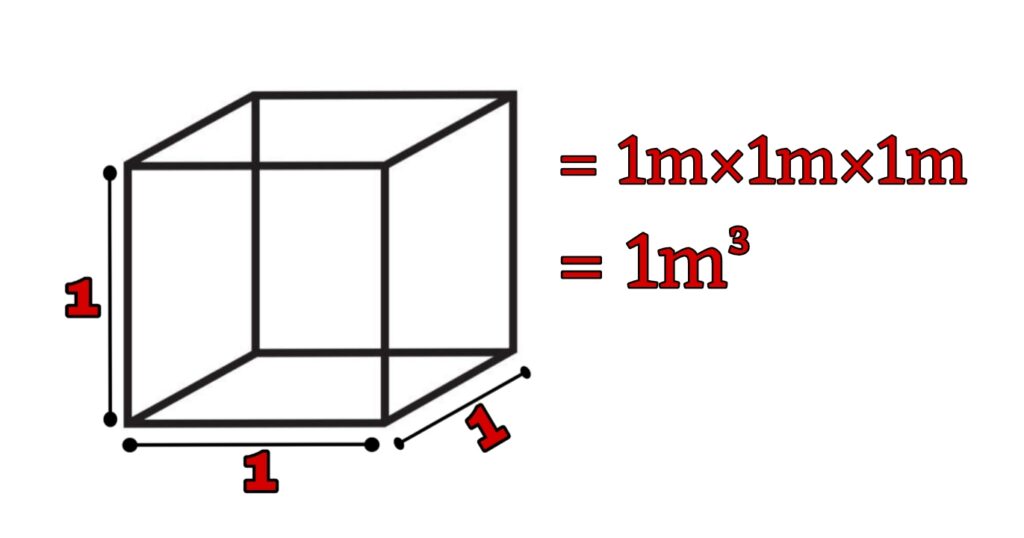
A cubic meter (m³) is a unit of volume in the metric system. It represents the volume of a cube.
1 meter long
1 meter wide
1 meter high
So,
1 m³ = 1m × 1m × 1m
It is mainly used in construction to measure concrete volume, excavation quantity, backfilling, plaster volume, and many other works.
Basic Formula to Calculate Cubic Meter:
Volume = Length × Width × Height
All measurements must be in meters.
If dimensions are given in feet, convert them into meters first.
1 meter = 3.281 feet
1 cubic meter = 35.3147 cubic feet
Step-by-Step Method to Calculate Cubic Meter
Step 1: Measure the Length:
Use a measuring tape and measure the length of the object or area in meters.
Step 2: Measure the Width:
Measure the width of the object in meters.
Step 3: Measure the Height (or Depth): Measure the height or depth of the object in meters.
Step 4: Multiply All Three Values:
Multiply length × width × height.
That result will be the volume in cubic meter (m³).
Example 1: Concrete Slab Volume Calculation
Suppose a slab has:
Length = 5 meters
Width = 4 meters
Thickness = 0.15 meters
Now apply formula:
Volume = 5 × 4 × 0.15
Volume = 3 cubic meters
So, concrete required = 3 m³
Example 2: Excavation Quantity Calculation:
Suppose excavation dimensions are:
Length = 10 meters
Width = 2 meters
Depth = 1.5 meters
Volume = 10 × 2 × 1.5
Volume = 30 m³
So excavation quantity is 30 cubic meters.
If dimensions are given in feet, first calculate cubic feet:
Volume (cft) = Length × Width × Height
Then convert to cubic meter:
Cubic meter = Cubic feet ÷ 35.3147
Example:
Room size = 10 ft × 10 ft × 10 ft
Volume = 1000 cubic feet
Convert into cubic meter:
1000 ÷ 35.3147 = 28.32 m³ (approx)
Cubic Meter for Circular Shape (Column or Tank)
If the shape is circular, use this formula:
Volume = π × r² × h
Where:
π = 3.14
r = radius (half of diameter)
h = height
Example:
Column diameter = 0.4 m
Radius = 0.2 m
Height = 3 m
Volume = 3.14 × (0.2)² × 3
Volume = 0.3768 m³ (approx)
Why Cubic Meter Calculation is Important?
Cubic meter calculation is important because:
- Helps in concrete estimation
- Useful in soil excavation calculation
- Required for sand and aggregate quantity
- Helps in billing and contractor payment
- Prevents material wastage
- In civil engineering, wrong volume calculation can cause financial loss and site problems.
- Common Mistakes to Avoid
- Mixing meter and feet units
- Forgetting to convert thickness into meter
- Using wrong formula for circular shape
- Not measuring accurate dimensions
- Always double-check units before multiplying.
- Simple Tips for Accurate Calculation
- Always convert all dimensions into meters first
- Use proper measuring tape
- Write values clearly before calculation
- Recheck multiplication
- Practicing daily site measurements improves accuracy.
Conclusion:
Understanding how to calculate cubic meter is a basic but powerful skill in construction and civil engineering. The formula is simple: Length × Width × Height. Whether you are calculating slab concrete, excavation, column volume, or tank capacity, cubic meter calculation helps you estimate material properly and avoid losses.
With regular practice, anyone can master cubic meter calculation without using complicated tools. Just remember to keep units consistent and apply the correct formula.
If you are a civil engineering student or site engineer, this knowledge will help you in every project.