
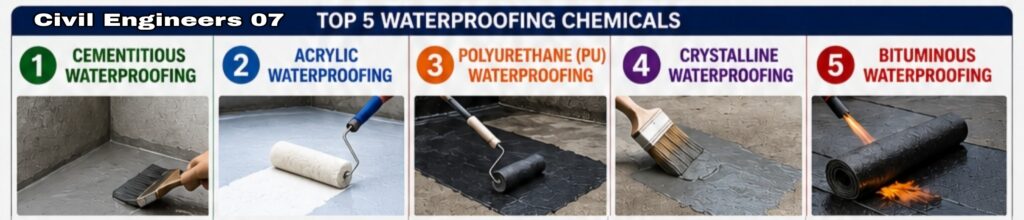
Importance of Waterproofing Waterproofing prevents water leakage, dampness, seepage, and moisture in concrete, and plays a vital role in protecting the durability of structures. It is critical to waterproof the roof, terrace, bathrooms, basement, water tanks, balcony, sunken slab, and external walls.What is Waterproofing Chemical Waterproofing chemicals are used to prevent water penetration into concrete by forming a coat, plugging pores in the concrete, or being added to the concrete mix. Waterproofing agents are broadly classified into cementitious waterproofing, acrylic waterproofing, polyurethane waterproofing, crystalline waterproofing, and bituminous waterproofing.
Top 5 Waterproofing Chemicals
-
- Cementitious Waterproofing
Use: This type of waterproofing is used for bathrooms, toilets, kitchens, water tanks, swimming pools, basements, concrete or masonry walls, and other internal wet surfaces.
Benefits: It provides excellent adhesion to concrete, is quick and easy to apply, economical, can be applied on wet surfaces, and is suitable for tile lining applications.
Limitations: It is a rigid waterproofing membrane, prone to cracking if the surface moves.
How to apply cementitious waterproofing chemical:
- Cementitious Waterproofing
-
- Prepare and clean the surface.
-
- Repair any cracks.
-
- Mix required quantities of the waterproofing agent.
-
- Apply the mixture in the form of coats.
-
- Carry out tests.
-
- Finish the surface.
-
- Acrylic Waterproofing
Use: Terrace, balcony, exterior walls, parapets, and surfaces with minor movements are suitable for acrylic waterproofing.
Benefits: It offers good flexibility, seamless appearance, UV resistance, water-based option, and quick and simple touch-ups and repairs.
Limitations: It cannot be used for permanently submerged surfaces or surfaces exposed to continuous water stagnation unless otherwise stated by the manufacturer.
How to apply acrylic waterproofing chemical:
- Acrylic Waterproofing
-
- Prepare the surface.
-
- Repair cracks.
-
- Apply a primer if necessary.
-
- Apply acrylic waterproofing in coatings.
-
- Allow it to dry.
-
- Carry out tests.
-
- Polyurethane (PU) Waterproofing
Use: Terraces, roof decks, podiums, balconies, sunken slabs, and commercial or industrial buildings are recommended for PU waterproofing.
Benefits: It offers high flexibility and bridges cracks easily, a seamless look, excellent adhesion to surfaces, and high water resistance.
Limitations: PU waterproofing membranes are expensive; sensitive to surface moisture; and require skilled applicators for installation.
How to apply PU waterproofing chemical:
- Polyurethane (PU) Waterproofing
-
- Check and prepare the surface.
-
- Undertake repairs to cracks and other defects.
-
- Check the moisture content of the surface.
-
- Apply primer if necessary.
-
- Install PU membranes.
-
- Allow membranes to cure.
-
- Carry out tests.
-
- Crystalline Waterproofing
Use: Crystalline waterproofing is used for underground structures such as basements, water tanks, lift pits, and foundations as well as retaining walls.
Benefits: This waterproofing method blocks water penetration in concrete, provides long-term waterproofing, and is ideal for concrete water-retaining structures.
Limitations: It tends to be ineffective on cracked surfaces. Crystalline waterproofing should not be used on expansion joints or other substrates requiring movement.
How to apply crystalline waterproofing chemical:
- Crystalline Waterproofing
-
- Prepare the surface.
-
- Remove any loose particles such as dust.
-
- Pre-wet the surface if necessary.
-
- Apply crystalline slurry evenly.
-
- Allow the slurry to cure.
-
- Seal the cracks and joints.
-
- Bituminous Waterproofing
Use: Bituminous waterproofing is applied to foundations, underground structures such as basements, retaining walls, roofs, terraces, and large surfaces.
Benefits: Bituminous membranes offer excellent water resistance and are ideal for large-scale applications, and can be manufactured as prefabricated membranes.
Limitations: Water tightness depends on the joints and overlaps, and bituminous membranes require applicators with torches for installation.
How to apply bituminous waterproofing:
- Bituminous Waterproofing
-
- Prepare the surface.
-
- Attach bituminous membranes to the surface.
-
- Make sure that the edges and overlaps are sealed.
-
- Allow the membranes to cure.
-
- Carry out tests.
- Comparison Summary
Waterproofing Type Best Application Flexibility UV Resistance Main Advantage
Cementitious Bathrooms, wet areas, water tanks Low to moderate Limited Economical & easy
Acrylic Terrace, balcony, external walls Moderate to high Good (depending on formulation) Flexible liquid coating
PU Terrace, roof deck, podium High Depending on formulation Exceptional crack bridging
Crystalline Basement, tanks, concrete N/A N/A Blocks water penetration in concrete
Bituminous Foundations, basements, roofs Depends on formulation Usually requires protection Strong water resistance
How to Choose Waterproofing Chemical
Waterproofing chemicals depend on the location and nature of the surface to be protected, cracks and water pressure, exposure to sunlight or temperature variations, presence of standing water, service life expectations, and budget. It is advisable to consider the level of skill required to apply the chosen waterproofing chemical and the manufacturer’s recommendations.
Mistakes To Avoid When Waterproofing
-
- Applying waterproofing membranes on damp surfaces unless otherwise specified
-
- Applying thin coatings
-
- Ignoring cracks or pipe penetrations
-
- Skipping the finishing and detailing of corners and joints
-
- Failing to carry out ponding/water tests
-
- Not following the manufacturer’s instructions or cure times
Final Notes
There is no best waterproofing chemical, but rather the choice depends on the intended application. The waterproofing method should be selected based on the surface, exposure, and movement. It is essential to follow the guidelines provided by the manufacturer when preparing the substrate, applying the chemical, and testing.
Frequently Asked Questions (Summary)
Adequate waterproofing depends on the surface, location, and exposure. Some chemicals offer enhanced flexibility, e.g., PU membranes, while others are more economical, e.g., cementitious chemicals. It is better to use cementitious waterproofing agents in bathrooms since they have good adhesion properties. Waterproofing is not a substitute for structural crack repairs, so it is advisable to consult a professional. Water testing should be carried out after waterproofing to ensure there are no weaknesses. Integral admixtures can also be added to concrete during its preparation. This short guide will help you choose the best waterproofing chemical for your construction site.
- Not following the manufacturer’s instructions or cure times